

Concepts & Terms
anti-natalist
pro-natalist
Thomas Malthus
Malthusian theory
neo-malthus
Examples
China’s One Child Policy
Population Bomb Panic
Cause & Effects
Aging countries and effects on
- economy
- government services
- social/family obligations
- dependency ratio
- working-age cohorts

Governments cannot plan for the future without thinking about people. Schools, hospitals, housing, roads, food supply, jobs, tax revenue, pensions, migration systems, and elder care all depend on population. A young country faces different needs than an aging country. A country with high fertility faces different pressures than one where deaths outnumber births. Population policy is how governments try to shape these patterns before they become crises. When leaders understand population, policy can expand opportunity and prevent suffering. When they misunderstand it, the consequences can be deadly.
Thomas Malthus is the classic starting point for understanding this problem. Malthus was writing in Europe during a period of rapid population growth. Today, we would connect that pattern to Stage II of the Demographic Transition Model: death rates were falling as food supply and basic living conditions improved, but birth rates remained high. From that viewpoint, population growth looked alarming.
Malthus argued that population was growing much faster than our ability to grow food. He predicted that the world was headed toward a crisis point of famine, starvation, disease, and war. What Malthus did not consider, and the reason his prediction turned out to be wrong, was human innovation and the complexity of carrying capacity. Human innovation in agriculture: improved seeds, crop rotation, irrigation, mechanization, fertilizers, refrigeration, transportation networks, global trade, and later the Green Revolution, allowed for the growing population.
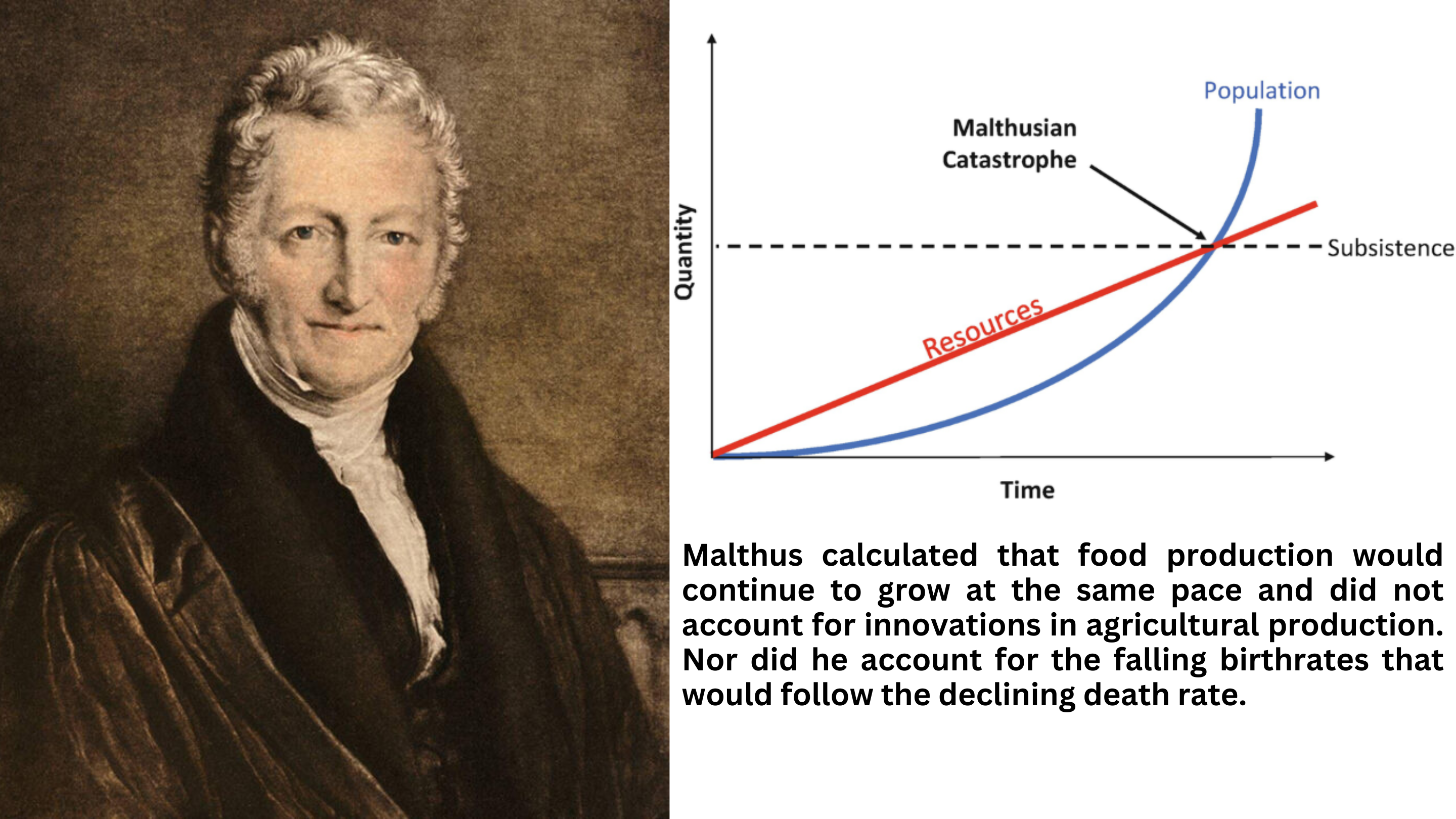
He also did not understand the full demographic pattern that Europe itself would eventually follow. As countries develop, urbanize, move away from subsistence agriculture, lower infant mortality, educate girls, and expand economic opportunity, total fertility rates usually decline. Population growth does not simply continue upward until disaster stops it. Development itself can change fertility behavior.
This is one reason carrying capacity is not fixed. Technology, trade, infrastructure, environmental limits, and political decisions all change how many people a place can support. A country may produce enough food but fail to distribute it fairly. A city may have enough land but not enough affordable housing. A country may have enough young people to create a demographic dividend but fail to provide the schools, jobs, and infrastructure needed to make that population productive.
When a potato infection spread across Ireland in the 1840s, wiping out a crop that many poor Irish tenant farmers depended on for survival, Malthusian ideas influenced political policy with catastrophic effects. Influenced by his ideas, political leaders in England (who controlled Ireland) saw the famine as a natural consequence of out-of-control population growth. This was not antinatalist policy in the modern sense of a government birth-control program. But it operated with a deadly antinatalist logic: population decline through starvation, disease, and emigration was tolerated as a correction rather than prevented as a policy failure. Close to 1 million Irish died from starvation-related disease, and another 2 million fled Ireland. The lesson is not only historical. It is a warning about leadership. When leaders use weak theory, prejudice, or oversimplified assumptions to understand population, real people pay the cost.
Smarter population policy begins with a fuller understanding of demographic change. If a government wants fertility rates to fall, the most effective tools are often not coercive at all. Girls’ education, women’s employment, access to contraception, family planning, maternal health care, lower infant and child mortality, literacy, urbanization, and economic diversification can all reduce fertility by changing the conditions of life. When infant mortality falls, families do not need to have as many children to feel confident some will survive. When girls stay in school longer, marry later, and have more economic opportunity, family size usually declines. When a country urbanizes, children often become more expensive to raise and less necessary as farm labor.
Antinatalist policies are policies designed to reduce fertility rates or slow population growth. Some are voluntary and development-oriented, such as expanding contraception, improving health care, educating girls, and helping families plan births. Others are coercive. Coercive antinatalist policies use fines, surveillance, forced contraception, forced sterilization, forced abortion, or punishment for unauthorized births. The important question is not only whether fertility falls. It is how fertility falls and what consequences follow. A policy that lowers fertility through opportunity can support development. A policy that lowers fertility through coercion can create trauma, distrust, gender imbalance, aging, and long-term demographic instability.
China’s One Child Policy is a modern example of this problem. Chinese leaders adopted the policy during a period of rapid population growth and concern that too many births would limit food security, modernization, and economic development. Like Malthus, they saw population growth as a threat to national stability. But China’s fertility rate was already beginning to decline due to earlier family planning campaigns, urbanization, education, and economic change. Instead of relying mainly on non-coercive tools—education, contraception, health care, lower infant mortality, women’s opportunity, and continued development—the state used harsh birth restrictions. The policy worked in the narrow sense that it reduced births, but it was almost like pressing fast-forward on demographic change. It reduced fertility faster and more forcefully than the Demographic Transition Model might have on its own.
The policy was not applied equally everywhere. Some rural families, ethnic minorities, and families meeting certain conditions could sometimes have more than one child. For many urban families, one child became the rule. Enforcement varied, but it could be severe: fines, job pressure, loss of benefits, forced contraception, forced sterilization, forced abortion, and punishment for children born outside the policy.
For several decades now, China has benefited from a demographic dividend. A large working-age population, fewer young dependents, rapid urbanization, export manufacturing, infrastructure investment, and global trade helped China industrialize at extraordinary speed. When a country has many workers and relatively fewer dependents, it has a window of opportunity. It can build factories, cities, roads, schools, technology, military capacity, and national wealth. China used that window more effectively than almost any country in modern history.
But that window does not stay open forever. The same policy that helped reduce the number of children also helped create a future with too few young people, too few women of childbearing age, too many older dependents, and a family structure in which one adult child may be expected to support two parents and four grandparents. China ended the One Child Policy and allowed all couples to have two children beginning in 2016. In 2021, it moved again toward a three-child policy. But changing the law proved easier than changing the culture the law helped build. For decades, the state taught people that small families were responsible, modern, and patriotic. Urban housing costs, long work hours, competitive schooling, youth unemployment, and gender inequality reinforced the same behavior. Now the state wants more births, but many young adults do not want the family size the government wants for them.
China’s current development strategy makes more sense when viewed against this demographic clock. China’s population has continued to shrink, birth rates remain very low, and the country is aging rapidly. Chinese leaders face a narrower window to turn today’s still-large working-age population into long-term wealth, technology, infrastructure, military strength, and global influence before aging makes growth harder. Rapid urbanization, high-speed rail, advanced manufacturing, electric vehicles, automation, artificial intelligence, and state-directed infrastructure investment are not only economic choices. They are also demographic choices. China is trying to become rich before it becomes too old.
Pronatalist policies try to solve the problem of an aging, or even shrinking population. These policies and programs encourage people to have more children. These are common in countries with aging populations, shrinking workforces, and very low fertility. Governments may offer paid parental leave, child tax credits, subsidized childcare, housing support, baby bonuses, fertility treatment coverage, flexible work rules, or public campaigns encouraging marriage and children. These programs try to make family life more affordable and less risky.
But increasing a population’s fertility is usually harder than lowering it. A government can change a law quickly, but it cannot easily change the economic and cultural conditions that shape family size. A family deciding whether to have another child is not only calculating a childcare subsidy. They are calculating rent, wages, job security, education costs, career interruptions, long work hours, and whether the future feels stable enough to bring another child into it. Once small-family expectations become the norm, pronatalist policies often have limited effect.
Aging populations show why low fertility becomes a national planning problem. When birth rates stay low and life expectancy rises, the population pyramid changes shape. The base narrows because fewer children are being born. The upper age groups widen because more people are living into old age. Over time, a smaller working-age population must support a larger retired population. This creates a rising old-age dependency ratio. Governments may spend more on pensions, hospitals, long-term care, and disability services while collecting less tax revenue from workers. Businesses may face labor shortages. Families may feel pressure as adult children care for aging parents while raising their own children, working full time, and continuing to struggle with the increased cost of living; thus making it more likely they will have fewer or no children.
Some countries turn to immigration to increase their working-age populations, since it can bring in adults faster than births. Migrants can fill labor shortages, support tax systems, staff hospitals and elder-care facilities, start businesses, and slow workforce decline. Countries do this with easy-to-obtain work visas that allow migrants to obtain jobs, create streamlined family unification policies, and outreach programs to attract new potential residents. Immigration policy can be an important part of a country’s population policy.
As a future global leader, regardless of whether you go into government work, lawmaking, or business, understanding population demographics and population policy is a powerful tool you will need to face the challenges of the 21st century. Understanding the topics in this and previous chapters helps you understand the present state of a country and what it needs for its population to thrive.